
Grace Notes
Volume 8 | March 2026

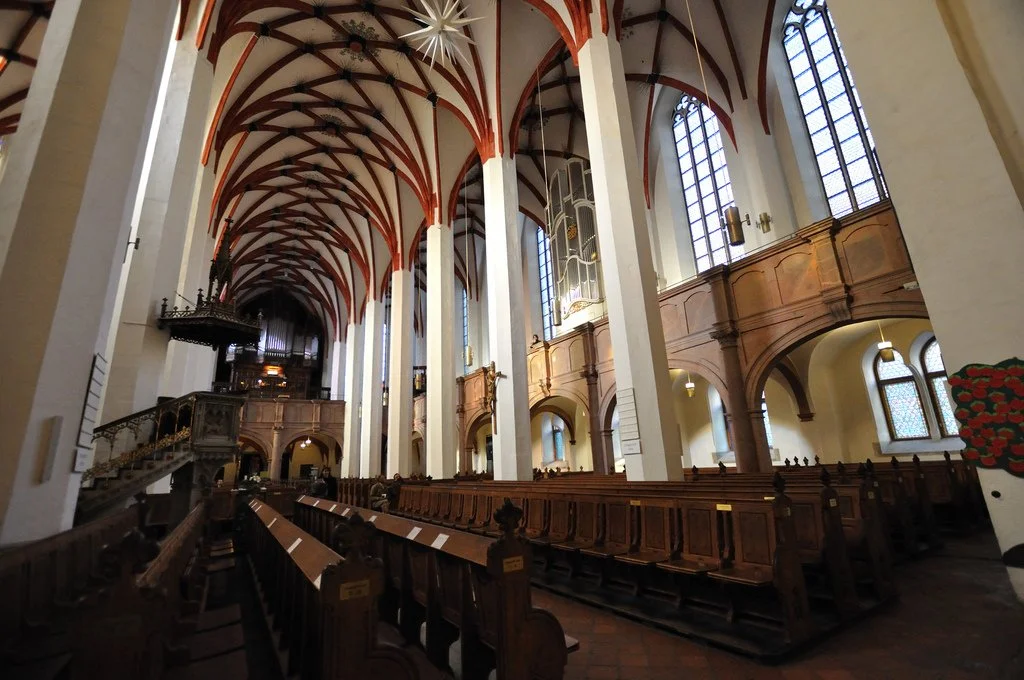
Above and below: Thomaskirche, Leipzig
Bach’s Easter Oratorio
DONNA GRANT REILLY
There is so much about Johann Sebastian Bach’s life that we will never know. We have most of his music, but a great deal of what has been written about his private life is conjecture. What were his thoughts, his motives? What emotions drove him to write such glorious music?
By 1729–30, Bach may have concluded that he’d provided the Leipzig churches with a large enough supply of cantatas to last them for a long time. Perhaps he was starting to work on ways to gradually reduce the non-stop demand for more by occasionally substituting a cantata or Passion oratorio by other composers—such as Telemann—while continuing to fulfill his duties as cantor. Also, Bach was probably aware that a few members of the Leipzig clergy and congregants had never been totally convinced that his cantatas represented a proper interpretation of the liturgy.
The Age of Enlightenment, which began in the 17th century and lasted well into the 18th, was a major force at the time. More emphasis was now placed upon creating great works that everyone (men) could understand, rather than weighty subjects studied only by learned scholars. As a result, the complicated and highly-ornamented music of the Baroque period was slowly giving way to a simpler, lighter, more melodic, galant style of music—tunes that one could hum when leaving the performance. This must have been somewhat disquieting for Bach, who valued above all else the perfection of his craft and the inherent emotional depth of his music.
By the mid-to-late 1730s, the dramma per musica, or musical drama, had become popular—largely because of Italian opera. During this period, Bach wrote a series of oratorios for Christmas, Easter, and the Ascension which employed many of the dramma characteristics. When he wrote his first Easter cantata, Bach pressed one of his already-existent works into service—a common practice at a time when the oratorio and cantata form were equally important in the Lutheran liturgy. He simply changed its original cast of four carefree country shepherds and shepherdesses into Christ’s disciples rushing to the empty tomb—a journey they were obliged to make without the assistance of any accompanying chorales.
Many years later, Bach re-visited the same cantata and completely reworked it into an oratorio that was substantially more polished and broadened. The Easter Oratorio we know today, despite its decidedly cursory beginnings, finally became a scriptural narrative that beautifully portrays the human emotion and faith inherent in the Easter story.
Sources: John Eliot Gardner, Music in the Kingdom of Heaven; Oxford Music Online
Table of Contents
INTERVIEW
Filippo Ciabattion UVB’s March and April Programs
MUSICIAN PROFILE
Paul Max Tipton, bass-baritone
PRE-CONCERT VIRTUAL PRESENTATION
Madrigals in Renaissance Italy
MUSICAL TERM
Italian Madrigal
INSTRUMENT
Oboe d’Amore
LOOKING BACK
Vivaldi’s The Four Seasons
What do you think?
We want Grace Notes to bring you interesting and educational pieces that help connect you to our work. Let us know what you want to see in this publication by emailing baroqueuv@gmail.com.
CREDITS
Donna Grant Reilly,
Editor-in-Chief
Jo Shute,
Contributing Editor
Mary Gerbi,
Contributing Editor
Catherine Hedberg, Design