
Grace Notes
Volume 8 | March 2026
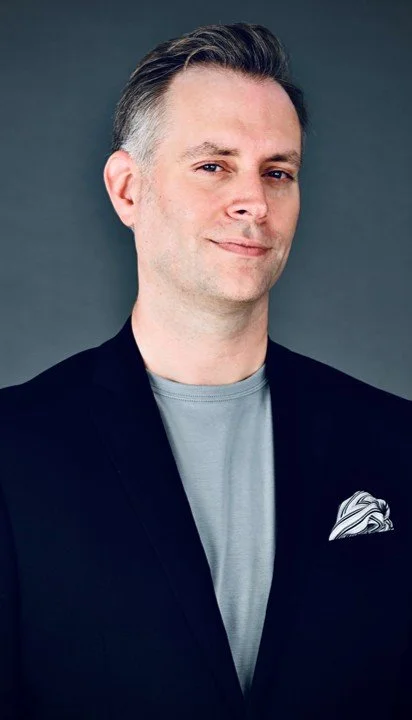
Bass-baritone Paul Max Tipton. Photo by Kevin Day
Described by the Atlanta Journal-Constitution as a dignified and beautiful singer, Paul Max Tipton performs and records in opera, concert, and chamber music throughout North America, Europe, and Asia. He recently made his solo debut in Tokyo performing Beethoven’s Symphony No. 9 with Bach Collegium Japan, and has also appeared with the Kansas City Symphony, Pacific Symphony, Seattle Symphony, Spoleto Festival USA, Tucson Symphony, and Göteborg Baroque. His recordings include Bach masterworks with Cantata Collective on AVIE Records and solo Bruhns cantatas at Yale ISM with Masaaki Suzuki on BIS. At Upper Valley Baroque, we’ve been fortunate to present him as a soloist in three different works by Handel: Dixit Dominus, L’Allegro, and Messiah. He also curated and performed in our March 2025 chamber concert. He holds an MMus from Yale University and resides in New York City.
Musician Profile
Paul Max Tipton
When you work on vastly different repertoire such as madrigals, opera, classical, or contemporary and beyond, do you prepare differently? If there are no recordings available of very old or newly-composed music do you have any special techniques or approaches?
It is a gift to be involved with so many different styles of music from so many different cultures and time periods. There is so much to learn and appreciate from the myriad of repertoire I encounter in a season.
Mastering such disparate music—as a Bach cantata, a song by Francesca Caccini, the role of Papageno in Mozart’s Magic Flute, an Alessandro Scarlatti oratorio, an air de cour in the late Renaissance, a solo motet by Isabella Leonarda, etc—is hard work but thankfully the pattern of study is always quite simple. It is always text first, then a composer’s notes and rhythms, followed by interpretation and context, and lastly applying a rigorous vocal technique. Giving myself enough time to follow this process allows for a deeper understanding in my mind and body, and thus this all translates to fruitful expression in performance for audiences. I feel there is no shortcut to this process. The best art comes as a result of the hardest work.
I tend not to learn music by listening to recordings. I love to reference good recordings but it’s usually a reward for myself after I have learned the music by myself in the studio.
If you were advising a young professional singer, who has the talent and aspires to “great heights” and fulfillment, what advice might you offer? Would it be different for different voice parts? What might you choose NOT to share?
Singing is an amazing celebration of the lived human experience, a celebration of ideas and inspiration. Singing is not only a demanding artistic study, but also a scientific wonder. The human body’s ability to be a focused resonator is one of the world’s marvels. I am always overjoyed to meet any young professional who might want to take up the burden of singing artist, and I would praise them for aspiring to great heights and fulfillment.
I typically like to ask two questions of young singers. What is the music that inspires you? Who is doing it at the highest level? I truly believe all the answers to a career hang on those two branches. As a young teenager I heard Mozart, Mendelssohn, Schubert, and Tchaikovsky, and my imagination was set on fire. I could not consume other great composers fast enough and my future was sealed, especially after encountering Bach and Handel. Then my life became about pursuing those world-class artists who did the music I loved.
But there is another basic element to incorporate, and that is taking leaps of faith. I had an important diction teacher in my life at the University of Michigan, and his methods were challenging and complete. He could sense in any student when they felt timid at the front of the class, performing for a room of peers. One time he stopped me and announced in front of everyone that I must not choose fear, but must choose boldness. If I chose to be brave, then I must then imagine its ability to inspire my colleagues. This lesson has never left me since!
Are there things I would not share with young professionals? Yes, I would be careful about mentioning what their vocal limits might be, both in the present and the future. You just never know who someone might grow into. I myself am a vastly improved singer and communicator from the days of my early study. And I credit that to those around me who encouraged and held high standards in front of me.
The last bit of advice I would impart would be: turn your phones off and put them in a drawer somewhere, under lock and key. Open more physical books and scores and throw yourself into serious study. In an ever distracted and digitized world, the study and practice of singing is an increasingly more precious ritual. We need young people to pick up the banner and carry it for future generations.
Paul Max Tipton will be singing in UVB’s upcoming “Italian Madrigals” chamber concert (April 24 and 25), with colleagues Nola Richardson (soprano), Kim Leeds (mezzo-soprano), Lawrence Jones (tenor), Sumner Thompson (baritone), and Michael Leopold (theorbo).
Table of Contents
INTERVIEW
Filippo Ciabatti on UVB’s March and April Programs
MUSICIAN PROFILE
Paul Max Tipton, bass-baritone
PRE-CONCERT VIRTUAL PRESENTATION
Madrigals in Renaissance Italy
MUSICAL TERM
Italian Madrigal
INSTRUMENT
Oboe d’Amore
LOOKING BACK
Vivaldi’s The Four Seasons
What do you think?
We want Grace Notes to bring you interesting and educational pieces that help connect you to our work. Let us know what you want to see in this publication by emailing baroqueuv@gmail.com.
CREDITS
Donna Grant Reilly,
Editor-in-Chief
Jo Shute,
Contributing Editor
Mary Gerbi,
Contributing Editor
Catherine Hedberg, Design