
Grace Notes
Volume 8 | March 2026
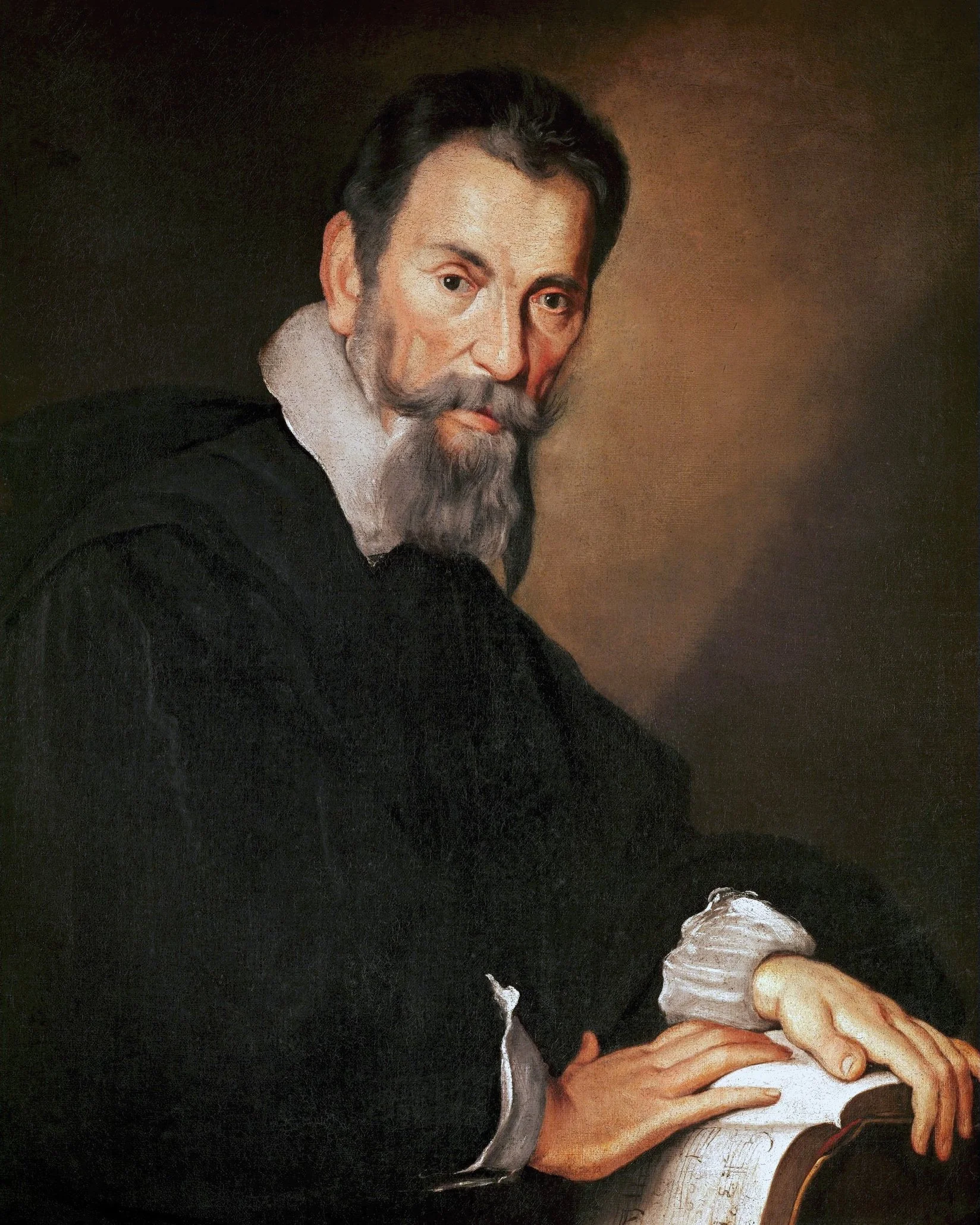
Monteverdi by Bernardo Strozzi
MUSICAL TERM
Italian Madrigal
MARY GERBI
The madrigal is the most emblematic form of secular music in Renaissance Italy. Madrigal composers set secular texts that are most often pastoral, allegorical, or lyric in nature. Though they are most often conveyed by a single speaker, each individual vocal line typically contains the full text set to its own expressive music. At the beginning of the sixteenth century, Northern composers such as Jacques Arcadelt and Philippe Verdelot, working mostly in Florence, wrote for four unaccompanied voices with relatively simple declamation, in a manner resembling the French chanson of the time. Inspired by the literary reform movement led by Pietro Bembo in the 1540’s, mid-century composers in Venetian circles such as Cipriano de Rore and Giaches de Wert began setting more ambitious poetry. Works for five voices became the standard, and they displayed more intricate use of harmony and rhythms that accentuated the declaration of the text. Additionally, musical “word painting”—such as using a falling motive to express a sigh, or flowing notes to resemble the wind—became a common device. In the latter part of the century, madrigal composition flourished in Rome and Ferrara. Composers such as Luca Marenzio and Carlo Gesualdo used intense chromaticism and virtuosic vocal writing to intensify the emotive qualities of their compositions. At the turn of the seventeenth century, “concerted” madrigals were introduced by composers such as Claudio Monteverdi, leading to more varied forces. Solos and duets became common, as well as larger groups; a basso continuo part was played by one or more instruments, and sometimes melodic instruments such as violins were added. With the instruments providing harmonic support, the voices were allowed even more freedom of expression. Whether accompanied or not, madrigals reached a peak of expressiveness and complexity as composers sought to reflect every emotional contour of the texts they were setting.
Table of Contents
INTERVIEW
Filippo Ciabatti on UVB’s March and April Programs
MUSICIAN PROFILE
Paul Max Tipton, bass-baritone
PRE-CONCERT VIRTUAL PRESENTATION
Madrigals in Renaissance Italy
MUSICAL TERM
Italian Madrigal
INSTRUMENT
Oboe d’Amore
LOOKING BACK
Vivaldi’s The Four Seasons
What do you think?
We want Grace Notes to bring you interesting and educational pieces that help connect you to our work. Let us know what you want to see in this publication by emailing baroqueuv@gmail.com.
CREDITS
Donna Grant Reilly,
Editor-in-Chief
Jo Shute,
Contributing Editor
Mary Gerbi,
Contributing Editor
Catherine Hedberg, Design