
Grace Notes
Volume 8 | March 2026
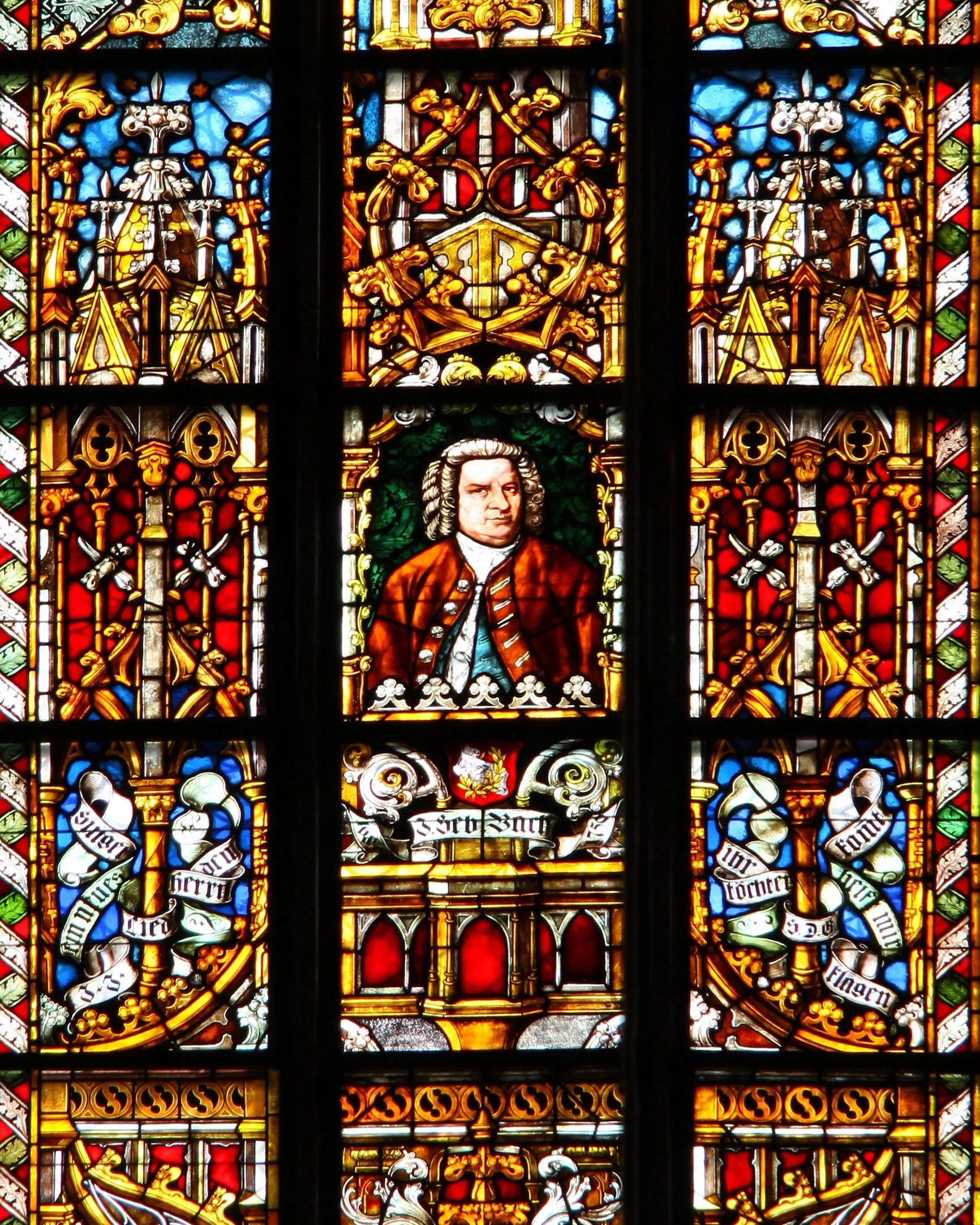
Bach window at Thomaskirche, Leipzig
oratorio or cantata?
MARY GERBI
The word “cantata” has long been used throughout Europe to refer to a work for voice and instruments, and like other musical terms, its meaning has shifted through time and cultures. Originating in early 17th-century Italy, cantatas were initially secular pieces for a solo vocalist with one or more instruments playing a basso continuo part, often used to display the singer’s emotional and virtuosic abilities. They typically included a combination of recitatives, ariosos, and arias. As often with popular secular forms, composers later adopted them for the church, first using sacred texts instead of secular, and later expanding the forces to include additional soloists, choruses, and more instruments.
Also originating in 17th-century Italy, the “oratorio” was a term used to refer to a sacred drama—a form that allowed composers to set a dramatic biblical narrative outside the context of opera, as staging them was forbidden by the church. Later spreading to France, Germany, and England, where the form was most famously developed by Handel, these became large-scale works for instrumental ensembles, multiple soloists, and chorus, using a combination of biblical and newly-written devotional texts. As in operas, recitatives carried the action, while arias served as points of emotional reflection.
Moving on to 18th-century Germany, J.S. Bach’s Passions are certainly oratorios by this definition, with the significant caveat that they were in fact performed within church services—not relegated to the oratorium (prayer hall) or a concert venue. The evangelist and other characters tell the story, while arias react to the developments therein. Meanwhile, Bach had famously provided church cantatas for virtually every week of the year. Lutheran cantatas developed into their own specific form, combining the intimate, solo-focused style of a cantata with larger forces, usually including an opening chorus and a final chorale, all mirroring the elements of a sermon and reflecting upon the specific day’s readings.
The Easter Oratorio is a special case: in choosing to apply the term “Oratorio” to the last of several versions of his work, Bach seems to have been signaling that he saw it as more substantial than many of his weekly cantatas. Interestingly, it does not contain chorales, even though his other oratorios do. While it has been argued that it does contain a narrative more typical of an oratorio, that is much less clear than in his Passions or even his Christmas Oratorio; the text here is still mostly reflective, with very minor involvement of the “characters,” who have brief interjections explaining what they’ve seen on Easter morning. Though Bach initially labeled the recitatives with the singer’s roles (Mary Magdalene, etc.), he omitted these names in his own final copy of the work.
So, is the Easter Oratorio in fact an oratorio, or is it a cantata? The answer could be: “yes.”
Table of Contents
INTERVIEW
Filippo Ciabatti on UVB’s March and April Programs
MUSICIAN PROFILE
Paul Max Tipton, bass-baritone
PRE-CONCERT VIRTUAL PRESENTATION
Madrigals in Renaissance Italy
MUSICAL TERM
Italian Madrigal
INSTRUMENT
Oboe d’Amore
LOOKING BACK
Vivaldi’s The Four Seasons
What do you think?
We want Grace Notes to bring you interesting and educational pieces that help connect you to our work. Let us know what you want to see in this publication by emailing baroqueuv@gmail.com.
CREDITS
Donna Grant Reilly,
Editor-in-Chief
Jo Shute,
Contributing Editor
Mary Gerbi,
Contributing Editor
Catherine Hedberg, Design