
Grace Notes
Volume 7 | December 2025
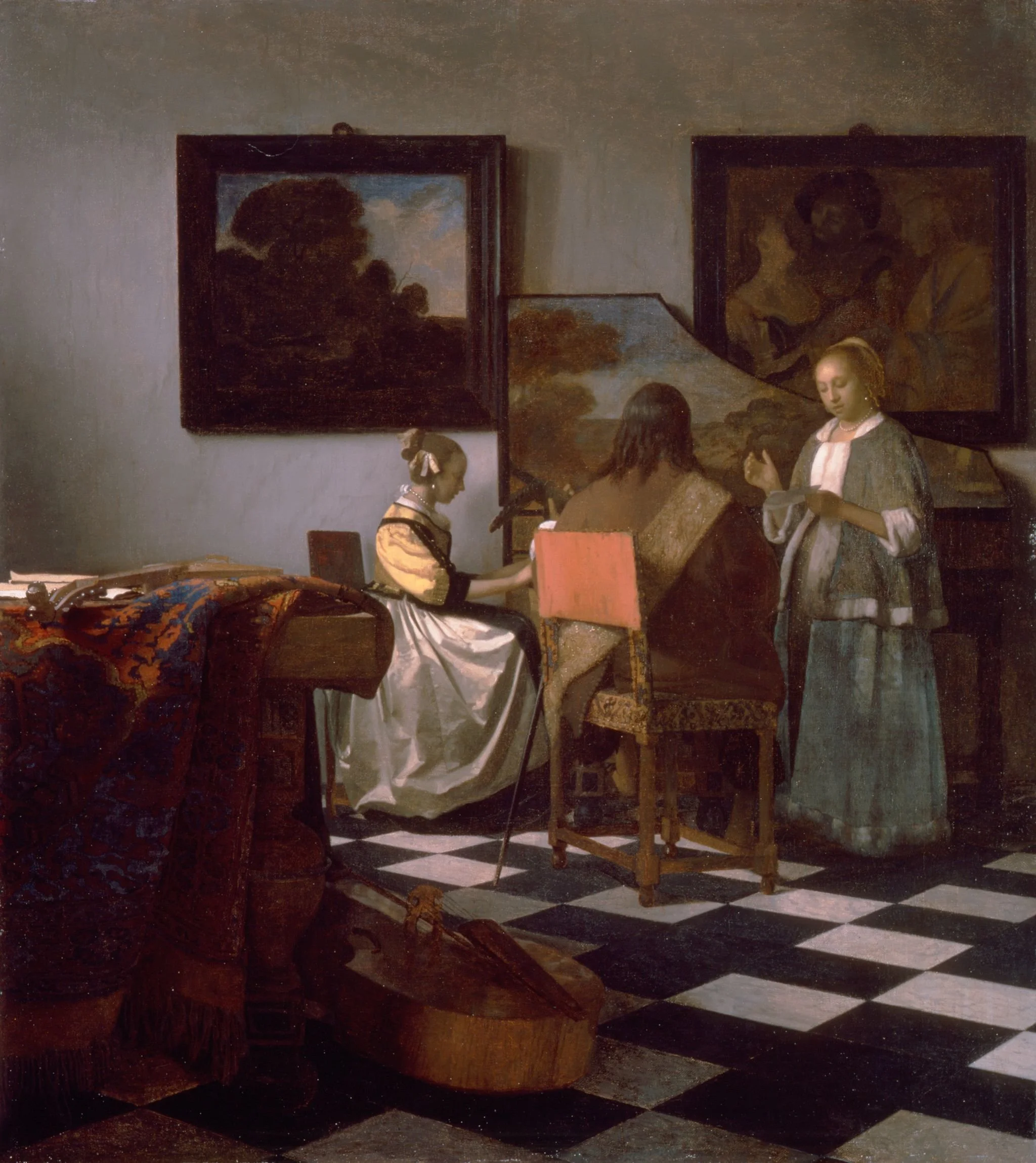
Johannes Vermeer, The Concert, 1663–1666; Wikimedia Commons
Why Baroque Music Now?
DONNA REILLY
We have vast amounts of music from all centuries available to us. Why then, is there so much music from the Baroque period performed today? Musicians are playing music written 400 years ago on instruments that were crafted to play it. We listen to it on the radio, on recordings, and in concert halls everywhere. There are hundreds of professional Baroque music groups worldwide. Why has it become so popular?
Recorded music didn’t exist in the 17th century. Public concerts were few and far between, so almost all musical entertainment was limited to what individuals could make for themselves. Playing music was part of nearly every family’s life. It was an important feature of their social life, religious observances, celebrations, and education. Most family members were taught to sing or play a musical instrument at an early age, and families played together for their own enjoyment. It was particularly important for young women to know how to sing and play a keyboard instrument such as the harpsichord, because these skills were a significant part of the courtship ritual.
Music performed outside the home was originally confined to small spaces where two or three musicians played for a few friends. Referred to as “Chamber Music,” these intimate gatherings eventually led to performances in grand concert halls with more musicians, more ambitious music selections, and audiences who now paid to attend. Baroque composers also began working for kings, emperors, and the Church, and their music was performed before much larger audiences.
Baroque music is characterized by its complicated structure and counterpoint. It creates a sense of balance, order, and predictability that feels deeply satisfying, and it generates a wide range of emotions. The music emphasizes contrasts between loud and soft, fast and slow; with dramatic effects from poignantly-rendered melodic passages, to spirited and lively dance tunes and comic capers. There is something here for everyone.
But during the Baroque era, this serene and predictable music was in stark contrast to the constant war, plague, and economic or religious turmoil occurring at the time. And possibly, perhaps inadvertently, it was welcomed as a distraction from the pain and suffering—a way to forget for a while the grim reality of everyday life by listening to satisfying, calming music.
Our situation today is eerily similar to that of the 17th century. We are constantly bombarded by distressing news on every front, and we’re desperately looking for a safe harbor! Have we found it in Baroque music? In this rapidly-changing world where we increasingly feel deeply unsettled, Vivaldi’s strong, insistent basso continuo still strides confidently along beneath a lovely, reassuring melodic line. And this is a good place to be.
Table of Contents
INTERVIEW
Filippo Ciabatti on Vivaldi
MUSICIAN PROFILE
Susanna Ogata, violin
MUSICAL TERM
Program Music
INSTRUMENT
Theorbo
PRE-CONCERT VIRTUAL PRESENTATION
Musician, Impresario, and Priest: Antonio Vivaldi
BUILDING COLLABORATION:
UVB Musicians Offstage
LOOKING BACK
Handel’s Messiah and
“Unknown Measures”
GRACE NOTES