
Grace Notes
Volume 7 | December 2025
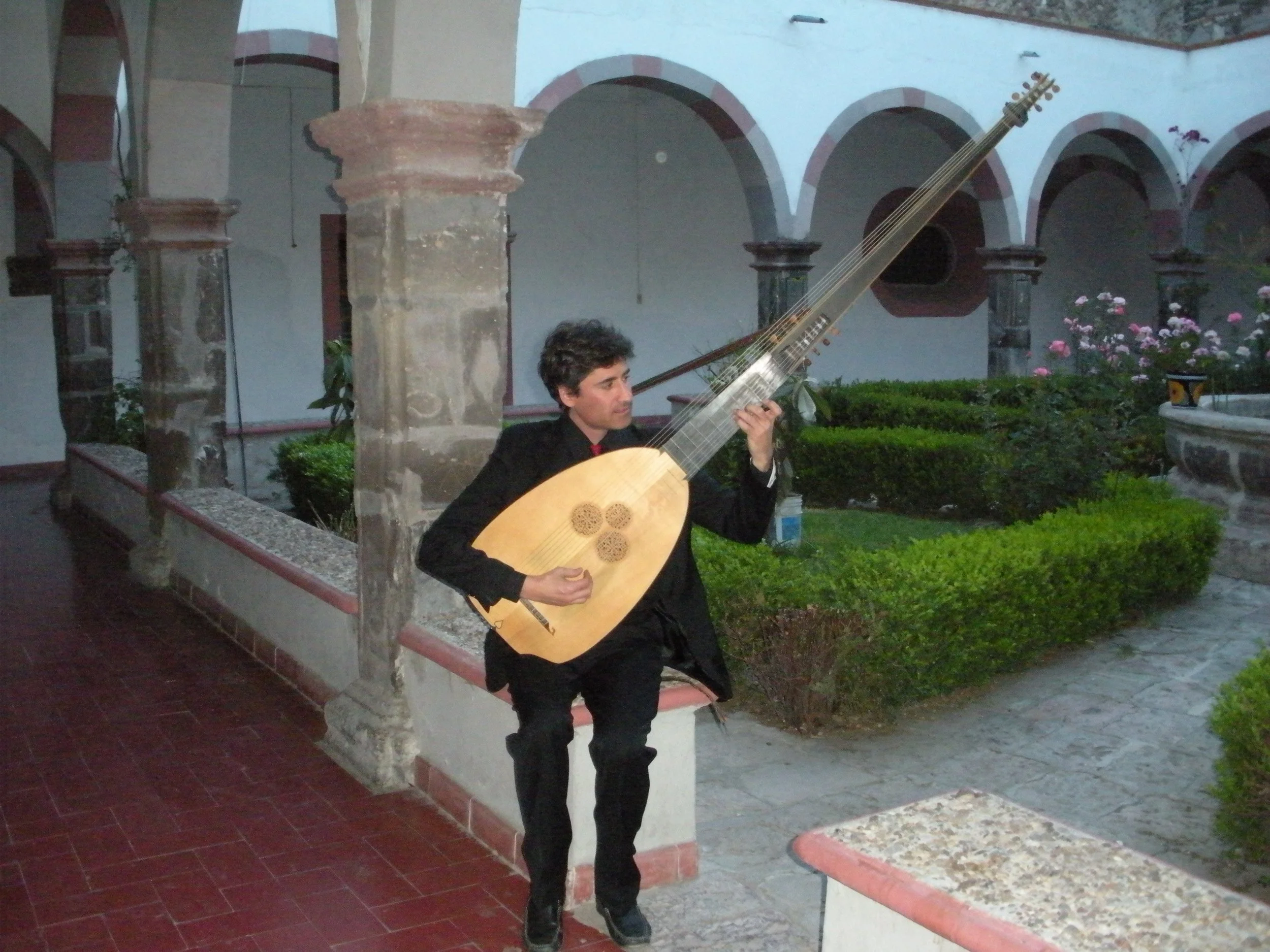
What’s That Thing With the Really Long Neck?
DONNA REILLY
The theorbo will be featured in UVB’s Vivaldi (January) and Italian Madrigals (April) programs.
In all likelihood, humans have always found increasingly better ways to improve musical instruments, ever since they discovered all sorts of ways to make music by blowing into hollow reeds, plucking on tightly-stretched strings of gut, or beating on things with a stick. The resulting sounds made a nice accompaniment to the noises they made with their throats. Some of today’s pop music is suggestive of those early attempts. We’ve generally had some kind of instrument with strings to pluck: early versions of the guitar, harps of various kinds, and the big, beautiful lute of the Renaissance period.
Toward the end of the 16th century, a group of Italian musicians figured out new ways of tuning their lutes so that the top two strings were an octave lower. By creating a really long neck, they created an instrument with a wider range, richer tone quality, and much brighter resonance than a lute—one that was able to produce a sound big enough to be heard clearly in a larger performance space. That creation is what we call a theorbo today, although it began with different names, such as chitaronne in Italian (a variation of the word chitarra, meaning large). Actually, it’s a giant bass lute that can be over six feet long, and typically has 14 or so strings.
Imagine the problems faced by a theorbist! Just getting it to the concert hall is an exercise in spatial relations. Toby Carr, a British theorbist, says he has managed to figure out how to carry his instrument around in cars, trains, planes, and bikes. In 2022 his theorbo had surgery; a hinge was added to allow the neck to fold, while still maintaining the tension on the long strings. He says that transporting it is now “a great deal easier and less conspicuous.”
Notation for a theorbo part does not look like most instrumental scores. Usually, all that’s written is a single bass part, often with “figures” which indicate which harmonies are necessary to fill out the accompaniment. In other words, the musician is expected to improvise and harmonize the notes around the single chord in a style appropriate to that of the composer that’s being played—similar to what jazz musicians do today.
Inigo Jones attempted to bring an Italian theorbo home to London in 1600, thinking it would be a welcome instrumental addition to the Baroque opera that was becoming popular in England at the time. Unfortunately, thanks to the strong anti-Catholic feelings of the time, Jones was stopped at the border and accused of bringing in some kind of papal machine of destruction. The theorbo didn’t make it to England until several years later.
The theorbo is perfectly suited to serve as a basso continuo instrument in the Baroque orchestra, often joined by a small organ. Its rich, melodic resonance is also the favored accompaniment to the human voice because it enhances the skills of a virtuoso soloist. Additionally, it is capable of contributing unique and subtle colors unavailable to other instruments in the orchestra.
The theorbo has inevitably gone the way of all musical instruments that have undergone changes over the centuries to meet the demands of changing tastes in music and modern materials and technology. It is still one of the most beautiful of instruments, not only to behold, but to hear. We will not see it in concert orchestras today, but, thanks to the current resurgence of early music and the existence of Upper Valley Baroque, we are privileged to enjoy again the sounds that audiences heard many centuries ago.
Table of Contents
INTERVIEW
Filippo Ciabatti on Vivaldi
MUSICIAN PROFILE
Susanna Ogata, violin
MUSICAL TERM
Program Music
INSTRUMENT
Theorbo
PRE-CONCERT VIRTUAL PRESENTATION
Musician, Impresario, and Priest: Antonio Vivaldi
BUILDING COLLABORATION:
UVB Musicians Offstage
LOOKING BACK
Handel’s Messiah and
“Unknown Measures”
GRACE NOTES